Happy Vaisakhi everyone!

It is Vaisakhi today, an event with several meanings to different cultures and religions.

Happy Vaisakhi

Happy Vaisakhi

It is celebrated by Hindus and Buddhists as part of welcoming the new solar year in.

But it is extremely important to the Punjabi community and the Sikh religion.  The time of Vaisakhi, or Baisakhi, as some say it, is a traditional harvest festival, and as the Punjab is a large farming area, it is a cause for celebration, when the crops are harvested, people dance, and have fun, they do Bhangra, sing and dance, and generally celebrate the freedom they will now have, after a successful (hopefully) harvest. But before all this fun and laughter, they use this time to pray, and thank God for the good harvest, and to pray for the future crops too.

As a Sikh it holds a great importance too.  Way back in 1699, our 10th Guru, Guru Gobind Singh Ji laid the foundations of the Panth Khalsa, or the Order of the Pure ones, and so it is the birth of the Khalsa, and Sikhism as we know it now.

Guru Gobind Singh Ji's Khalsa Panth

Guru Gobind Singh Ji’s Khalsa Panth

On this day many people who may not be baptised into full Sikhism, choose to do this, known as Amrit Shakna.  This is basically that you are drinking the holy nectar, Amrit, and you pledge to be a true Sikh, as above, remembering the 5 Kakar’s (the 5 K’s).

Kesh – Uncut Hair, you remain as God intended you to be, be thankful for what God gave you, do not be ashamed.

Kangha – A wooden comb worn in the hair, to keep you tidy, and presentable at all times, a symbol of cleanliness.

Kara – A steel bangle acting as a constant reminder of a Sikh’s mission on this Earth, to do good, and help others. It is an external symbol of our faith. Being a continuous circle, it shows a Sikh’s unbreakable attachment to God. It was also used in self defence, and originally was part of a type of coat of arms, to protect the arms in battles.

Kirpan – A ceremonial dagger carried by baptised Sikhs, that is there to defend oneself, but more over to protect others regardless of race, colour or creed.

Kashera – a loose shorts like undergarment. Used to retain ones modesty, and cover your intimate parts, so as to always be proper, and also, as it is worn by both man and woman, it is a way to discourage looking at the opposite sex in an immoral way. It is tied with a naala, a drawstring, and the meaning for that is that if you were to be removing it to do anything improper, then untying the knot would give you time to think about what actions you are about to make…

We celebrated today by going to the Gurdwara to pay our respects.

Then on the weekend, there will be a large parade, the Nagar Kirtan, which slowly snakes around our town, and all the local community, Sikh or not, get involved! We place our holy book, the Guru Granth Sahib, in a specially made trailer, resembling the Golden Temple in Amritsar, and then there are people walking ahead, cleaning the road in advance. The Panj Pyare, or Five Loved/Blessed Ones, Walk ahead of this carriage.

Panj Pyare

Panj Pyare

This procession is attended by thousands, who come from far and wide to walk alongside, and behind the Guru Granth Sahib.

Ariel Image

Ariel Image

We walk behind, chanting holy songs, and walk through the town, and around the route there are people giving food and drink, to all. This is part of our Seva, or helping others that we are encouraged to do. Many people, in the lead up to Vaisakhi will visit the temple and donate items such as juice and sweets, which are distributed along the journey. Also, local businesses will arrange for hot food and drink along the route, for free, as their ‘seva’ for Vaisakhi.
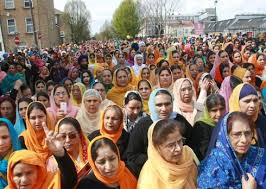
Some of the many people who attend

Some of the many people who attend

Behind the main hoards of worshippers there are usually trailers for those that can’t walk the couple of miles that we travel, and also local sports teams or cultural clubs have their participants on board open sided lorries.  That’s where I’ll be, as I have been the last 4 years. Previously they were on a trailer together as they play the Dhol, (Punjabi Drum) with a local Bhangra team, but this year Lil Man is on a trailer with his football team, and Lil Princess will be sat with her Punjabi School classmates. I hope to get a seat somewhere as my feet may not cope with the long walk this year!

And we have Bhangra dancers, performing along the route at various stations.

Bhangra Dancers

Bhangra Dancers

It is a beautiful event, and there are Nagar Kirtans around the UK in places where there is a large Sikh community.  Hopefully, I’ll get some pictures on Saturday, which I can post for you!

But for now,

HAPPY VAISAKHI TO ONE AND ALL!

Waheguru Ji Ka Khalsa, Waheguru Ji Ki Fateh

(Wonderful Lord’s Khalsa, Victory is to the Wonderful Lord)

#SoCS May 13/17 – Language

Lind’s prompt for #SoCS this week…

Your Friday prompt for Stream of Consciousness Saturday is: “language.” Use it any way you’d like. Have fun!

So here we have a poem I penned, which was inspired by a post a wrote a while back. It’s linked to the last word of the poem, if you wish to click through and read!

 
My mother tongue
is Punjabi
Mixed with accents
of Swahili
But what I speak
the most at home
At work, at school
and on the phone
Is English because
that’s where I was born
To choose a first language
I am always torn
My ‘mother tongue’
or my ‘step mum’ one?
To accept one,
the other to shun?
Or to celebrate
the presence of all three
And to call it
Pun-gli-hili?

socsbadge2016-17-1


My husband’s brother’s wife’s uncle!

I’ve treated myself to a bit of a cultural education this week.

Now I’ve always known that in Punjabi, we have specific names for different relations, so, with one word we can convey exactly how someone is related to us, more or less.
In English, if I said Aunty, you would need to ask how, so I’d have to explain she’s my mother’s sister, or mothers brothers wife, etc. why use do many words, when just one can convey so much?

I thought I’d give you all a lesson in Punjabi relation names!

Your nuclear family
Mataji/Maaji – mother
Pitaji/Papaji – father
Veerji/bhraji – brother
Bhenji/Didi – sister
Pati – husband
Patni – wife
Soura – father in law
Saas – mother in law
Jijaji – sister’s husband
Bhabiji – brother’s wife

Let’s go one step further
Nanaji – Maternal grandfather
Naniji – Maternal grandmother
Dadaji/Babaji – Paternal grandfather
Dadiji/Bibiji- Paternal grandfather

So,then there is
Pota – grandson, son’s son
Poti – grand daughter, son’s daughter
Dota – grandson, daughter’s son
Doti – grand daughter, daughter’s daughter

A step further? Ok,
Par Nanaji – maternal great grandfather
Par Nanaji – maternal great grandmother
Par Dadaji – paternal great grandfather
Par Dadiji – paternal great grandmother

Which needs
Parota – great grandson
Paroti – great granddaughter

Uncles and aunts? Yup, heck I’m just getting started!!
Tayaji – paternal uncle, Father’s older brother
Taiyji – paternal aunt, father’s older brother’s wife
Chachaji – paternal uncle, father’s younger brother
Chachiji – paternal aunt, father’s younger brother’s wife
Bhuaji – paternal aunt, father’s sister
Phupherji – paternal uncle, father’s sister’s husband
Mamaji – maternal uncle, mother’s brother
Mamiji – maternal aunt, mother’s brother’s wife
Masiji – maternal aunt, mother’s sister
Maserji – maternal uncle, mother’s sister’s husband

Then you need nephews and nieces!
Bhatija – nephew, brother’s son
Bhatiji – niece, brother’s daughter
Bhanja – nephew, sister’s son
Bhanji – niece, sister’s daughter

Cool? Confused yet? No? Ok, more!!!
Jeth – husband’s older brother
Jethani – husband’s older brother’s wife
Deor/devar – husband’s younger brother
Darani/de rani – husband’s younger brother’s wife
Nanaan – husband’s sister
Nandoya – husband’s sister’s husband
Saala – wife’s brother
Salehaar – wife’s brother’s wife
Saali – wife’s sister
Sadu – wife’s sister’s husband

Phew!!

Now, I already knew most of these. I’ve grown up with them, and apart from one or two which I checked with my mother in law (MIL) I was quite impressed with myself! Then she opened a whole other can of worms! There were more differentiated names ??!! Really? I thought that was plenty! Oh no, there are different names for your husband’s family too! Plus she didn’t know all of them, but if I learned something new, I’ll share with you too!

Dadora – husband’s paternal grandgather
Dadez – husband’s paternal grandmother
Nanora – husband’s maternal grandfather
Nanez – husband’s maternal grandmother
Malora – husband’s maternal uncle
Mamez – husband’s maternal uncle’s wife

That’s all she knew, and she offered to find out more, but by the. My head was buzzing!!!! I know some of you will think, OMG!! I’ll stick to uncle, aunt, cousin etc… But isn’t it great that with one word I can tell you so much about that person and their connection to me? Granted it doesn’t always trip off the tongue. I have to think and double check, but I love it! One day my children will fully understand it too… I hope!!

I love my culture!!
P.S. Did I miss anything??

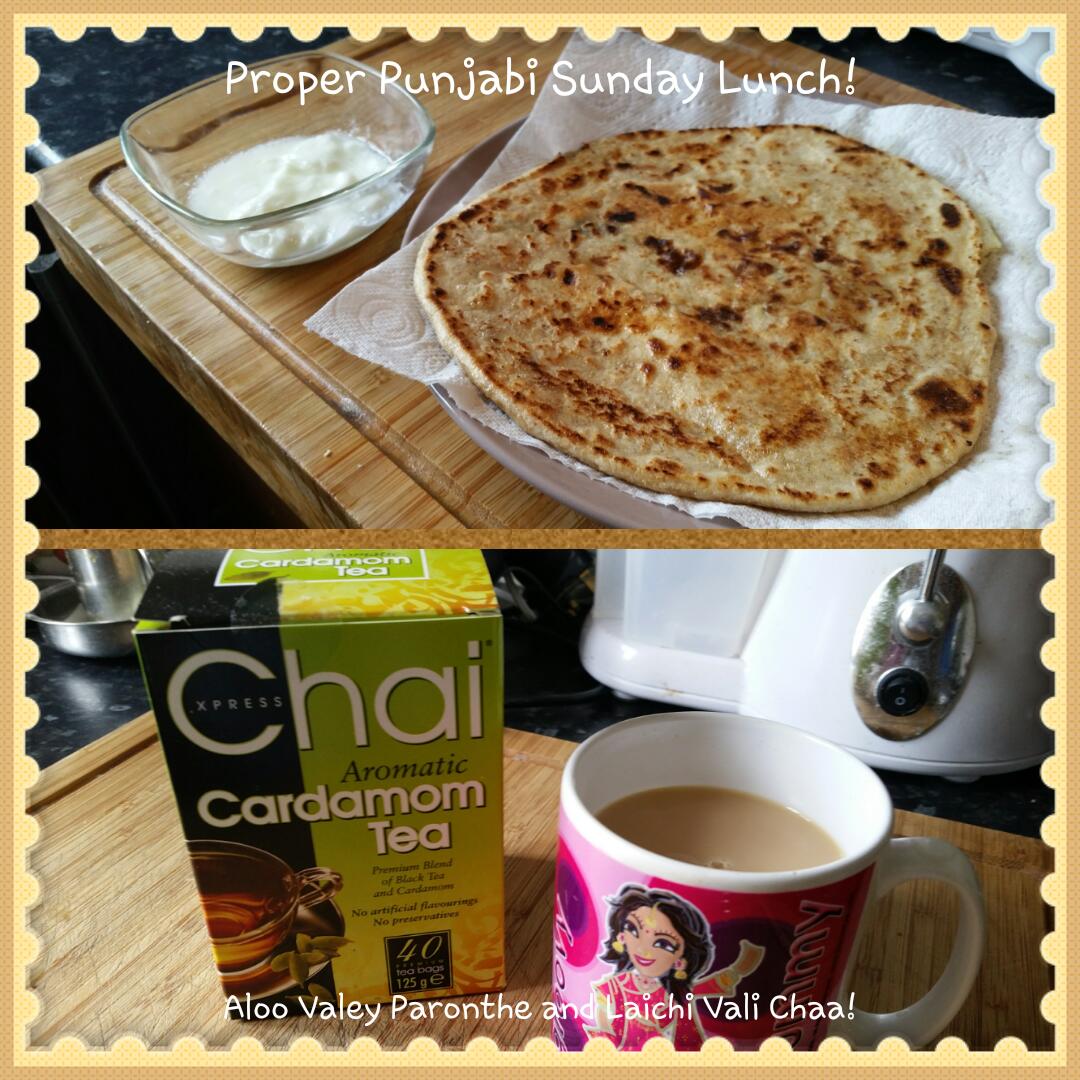
Proper Punjabi Style Sunday Lunch!

image

Usually my Mother In Law (MIL) is round, we regularly have this… But since they’ve been away, we missed em…
What are they?
Stuffed Aloo Valey Parathe with spiced tea!
Basically, potato stuffed chapattis, that are lightly fried, with yoghurt, an maybe a knob of butter and pickle!
Washed down with true Indian masala Chair would be better, but I didn’t have time so I used my cheat, Cardamom spiced tea bags!
I made em myself… They’re not perfect, but they’re my attempt!!

But I Smile Anyway...

Indian, anyone?(Recipe)

image

One of my curries with Paneer

A good while back I assured my good blogpal Tom I would post a simple, authentic curry base recipe. This is your true base for pretty much all Punjabi cuisine. I hope you might take the time to try it out with whatever variation you wish, and let me know!

Punjabi Curry Base
You will need:
Vegetable oil
Cumin
White onion
Garlic
Ginger
Green chillies
Salt
Chopped or fresh tomatoes
Turmeric
Garam Masala

Heat some oil in a pan, about a couple of tablespoons.
Add a teaspoon of whole cumin seeds.
When they start to sizzle, which will be rather quickly, add a large diced onion.
Fry on a medium flame for a while until the onions are nicely browned.
Add a couple of cloves of minced garlic and around an inch of minced ginger and fresh chopped chilli to taste. 
Fry for a short while until these have also browned.
Top tip!  If you find that this is starting to stick to the bottom, add a small amount of salt, it will stop the sticking!
Now add a tin of chopped tomatoes, half a teaspoon of turmeric powder, and half a teaspoon of garam masala powder.
Allow the mixture to cook on a low heat for a while  stirring occasionally, until the oil starts to rise to the top.

This is the base for pretty much all home made curries!

If you want a curry with a bit of a gravy then add whatever you are planning on cooking, like chicken or lamb, with potatoes and/or peas, and coat in the mixture then add water to the desired amount for a nice gravy. Then allow to cook! Lamb will take around an hour, chicken quicker, but check periodically to see when the meat and potatoes are cooked.
You could put a tin of kidney beans or chick peas and potato, with water for vegetarian alternative.
For a drier dish you could add mince and peas, no water needed and cook in the base.
Or add whatever veg you like! If using potato, add that first as it takes longer than most other veg, then add others once it’s partly cooked, like cauliflower, diced carrots and peas, aubergine, that sort of thing! 

Once cooked, taste to see if you want to add any more salt.

Hopefully this would create a tasty, authentic homemade curry for you! 

Enjoy!

My interactive peeps!

  • Unknown's avatar
  • Unknown's avatar
  • Unknown's avatar
  • Unknown's avatar
  • Unknown's avatar
  • Unknown's avatar
  • Unknown's avatar
  • Unknown's avatar
  • Unknown's avatar
  • Unknown's avatar
  • Unknown's avatar
  • Unknown's avatar
  • Unknown's avatar
  • Unknown's avatar
  • Unknown's avatar
  • Unknown's avatar
  • Unknown's avatar
  • Unknown's avatar
  • Unknown's avatar
  • Unknown's avatar
  • Unknown's avatar
  • Unknown's avatar
  • Unknown's avatar
  • Unknown's avatar
  • Unknown's avatar
  • Unknown's avatar
  • Unknown's avatar
  • Unknown's avatar
  • Unknown's avatar
  • Unknown's avatar
  • Unknown's avatar
  • Unknown's avatar
  • Unknown's avatar
  • Unknown's avatar
  • Unknown's avatar
  • Unknown's avatar
  • Unknown's avatar
  • Unknown's avatar
  • Unknown's avatar
  • Unknown's avatar
  • Unknown's avatar
  • Unknown's avatar
  • Unknown's avatar
  • Unknown's avatar
  • Unknown's avatar
  • Unknown's avatar
  • Unknown's avatar
  • Unknown's avatar
  • Unknown's avatar
  • Unknown's avatar