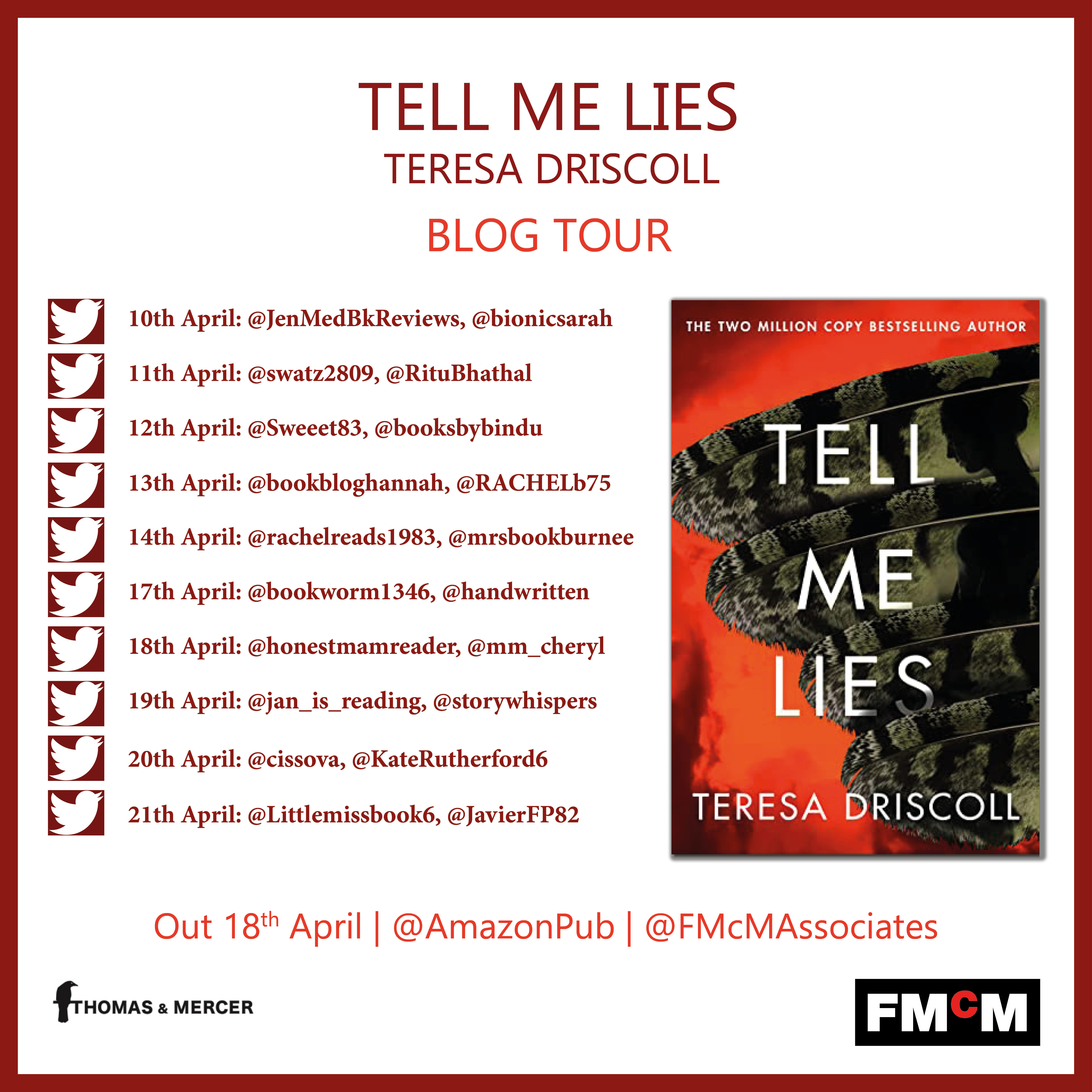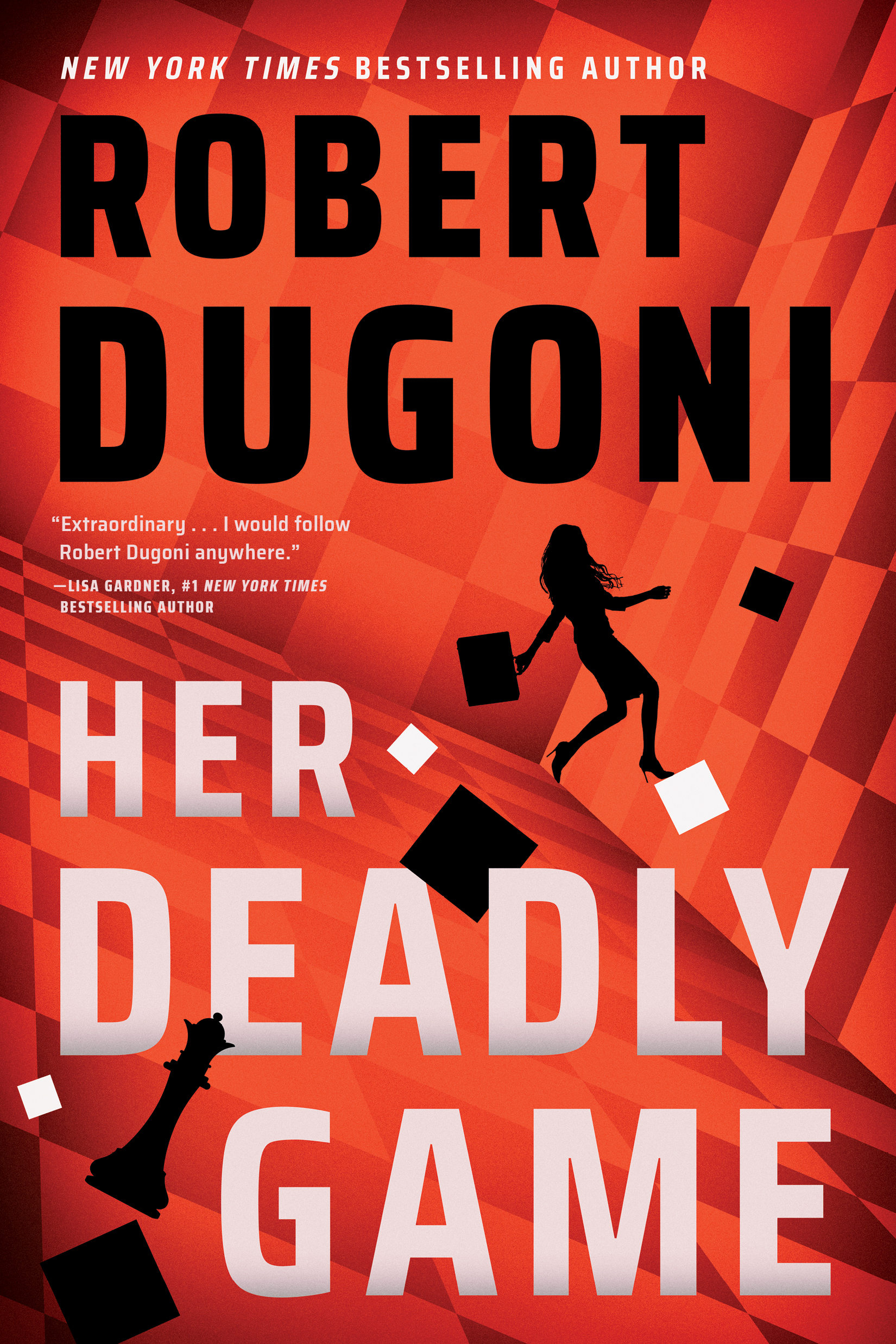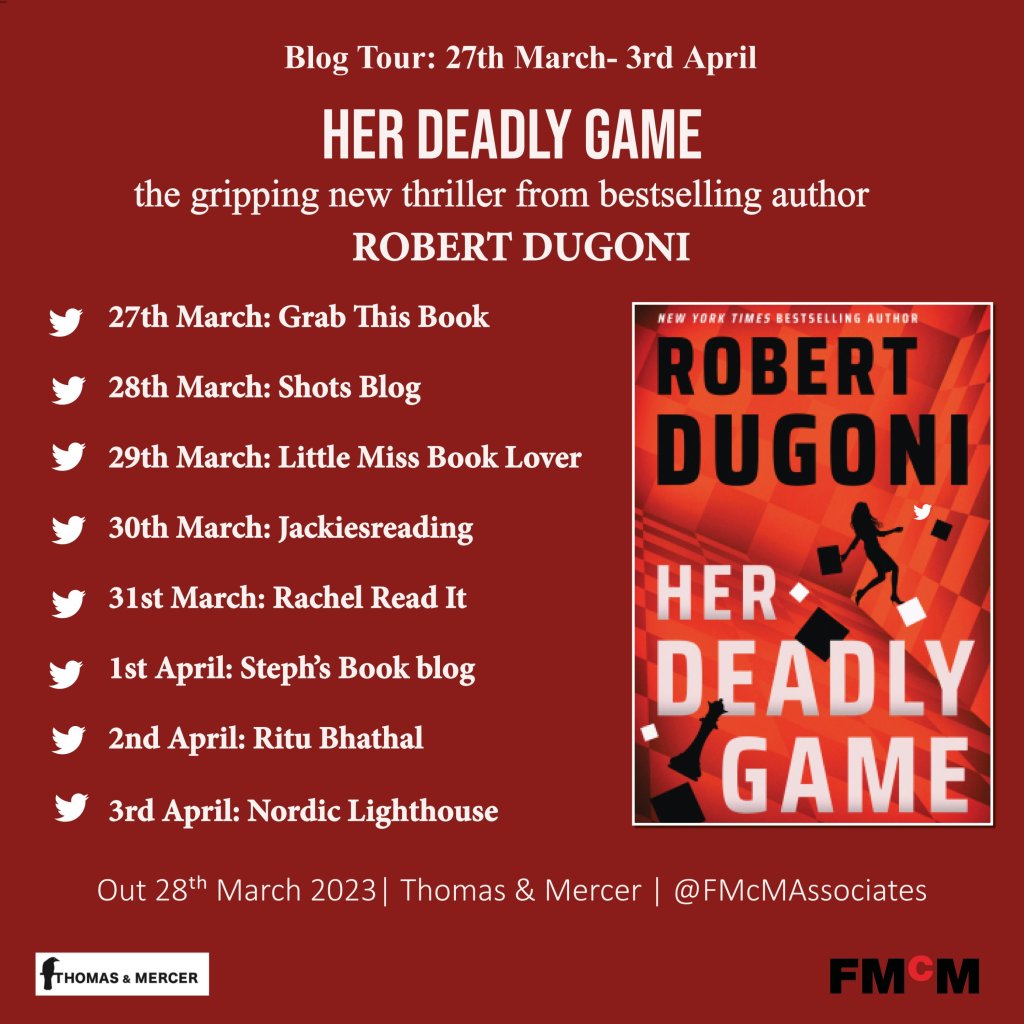
Something a bit different from me, today. I am on the blog tour for a Police Procedural/Crime Fiction novel by Robert Dugoni, Her Deadly Game
The Blurb
Keera Duggan was building a solid reputation as a Seattle prosecutor until her romantic relationship with a senior colleague ended badly. Now, returning to her family’s failing criminal defence law firm to work for her father is her only option. But with the right moves, maybe she can restore the family’s reputation, her relationship with her father, and her career.
Keera’s chance to establish herself comes when she’s retained by Vince LaRussa, an investment adviser accused of murdering his wealthy wife. There’s little hard evidence against him, but considering the couple’s impending and potentially nasty divorce, LaRussa faces life in prison. The prosecutor is equally challenging: Miller Ambrose, Keera’s former lover, is eager to destroy her in court on her first homicide defence. But as a competitive former chess prodigy, Keera is confident she can outmanoeuvre him.
As Keera and her team start digging, they uncover more than they bargained for. Keera is sure that LaRussa didn’t kill his wife, but she’s starting to suspect that he’s not an innocent man. With a duty to her client, her family’s legacy, and her own future to consider, she’s caught in a deadly game…
I always say I’m not a crime fiction kind of gal, but then I pick up a book, like this one, part courtroom drama, part police procedural, with a whole load of family drama thrown in, and I find myself sucked in. Her Deadly Game focuses on a lawyer, Keera, who, through no fault of her own, has to leave one job and go, tail between legs, to work with her father and sisters in their family law practice. She becomes embroiled in one case that she ends up heading after being the after-hours lawyer on duty, which could make or break her. A murder. Someone with a motive, but many, many other aspects that don’t tie up, as well as an alcoholic father threatening to put the case in jeopardy and an ex who ends up causing her hell in the courtroom. Keera’s old interest in playing chess also plays a part in the story. I’m not a chess player, so the different moves and names of pieces meant little to me, but I liked the parallel that was created between the tension in her working life and the online game she is playing. All in all, I really enjoyed reading this. A definite page turner.
About the Author
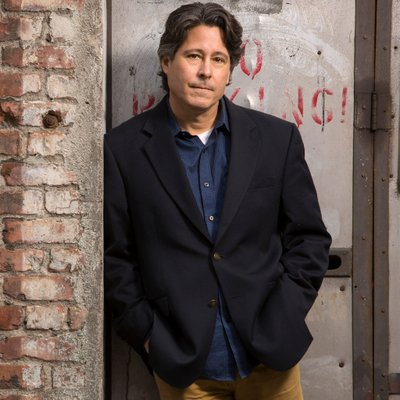
Robert Dugoni is the critically acclaimed New York Times, Wall Street Journal, Washington Post, and Amazon Charts bestselling author of the Tracy Crosswhite series, which has sold more than eight million books worldwide. He is also the author of the bestselling Charles Jenkins series; the bestselling David Sloane series; the stand-alone novels The 7th Canon, Damage Control, The World Played Chess, and The Extraordinary Life of Sam Hell, Suspense Magazine’s 2018 Book of the Year, for which Dugoni won an AudioFile Earphones Award for narration; and the nonfiction exposé The Cyanide Canary, a Washington Post best book of the year. He is the recipient of the Nancy Pearl Book Award for fiction and a three-time winner of the Friends of Mystery Spotted Owl Award for best novel set in the Pacific Northwest. He is a two-time finalist for the Thriller Awards and the Harper Lee Prize for Legal Fiction, as well as a finalist for the Silver Falchion Award for mystery and the Mystery Writers of America Edgar Awards. His books are sold in more than twenty-five countries and have been translated into more than two dozen languages.
Today I am bringing you a beautiful story written by Sarit Yishay-Levy, and translated by Gilah Kahn-Hoffman.
The Blurb
A mesmerizing novel about three generations of women who have lost each other—and the quest to weave them back into a family. An immersive historical tale spanning the life stories of three women, The Woman Beyond the Sea traces the paths of a daughter, mother, and grandmother who lead entirely separate lives, until finally their stories and their hearts are joined together. Eliya thinks that she’s finally found true love and passion with her charismatic and demanding husband, an aspiring novelist—until he ends their relationship in a Paris café, spurring her suicide attempt. Seeking to heal herself, Eliya is compelled to piece together the jagged shards of her life and history. Eliya’s heart-wrenching journey leads her to a profound and unexpected love, renewed family ties, and a reconciliation with her orphaned mother, Lily. Together, the two women embark on a quest to discover the truth about themselves and Lily’s own origins…and the unknown woman who set their stories in motion one Christmas Eve.
Firstly, I want to say that translated fiction can be quite hard to read. Sometimes things literally get ‘lost in translation’. Phrases used commonly in the original language can sound strange when written to suit a different tongue. However, despite taking a little time to get into it, The Woman Beyond The Sea was a beautiful story about a daughter, her mother, and their relationships. Eliya finds herself in emotional turmoil after her marriage breaks, especially since she was warned against the union by her family. She goes through several unstable phases, including suicidal thoughts, which are not helped by her mother, Lily, who can’t seem to find love or compassion for her only daughter, Lily, herself, is a damaged creature with no stable foundations and far too much heartache, despite having the love of a good man forever behind her and beside her. Ultimately this is a story of discovering one’s self, and in The Woman Beyond The Sea, Lily and Eliya go on a bumpy ride to find out why they feel the way they do about one another and those around them. Sometimes there was repetition and more than one POV in a named POV chapter, but I was immersed in the story and spent an entire day in bed wanting to read more!
About the Author
Sarit Yishai-Levi is a renowned Israeli journalist and author. In 2016 she published her first book, The Beauty Queen of Jerusalem. It immediately became a bestseller and garnered critical acclaim. The book sold more than three hundred thousand copies in Israel, was translated into ten languages, and was adapted into a TV series that won the Israeli TV award for best drama series. It also won the Publishers Association’s Gold, Platinum, and Diamond prizes; the Steimatzky Prize for bestselling book of the year in Israel; and the WIZO France Prize for best book translated into French. Yishai-Levi’s second book, The Woman Beyond the Sea, was published in 2019. It won the Publishers Association’s Gold and Platinum prizes and was adapted for television by Netflix. Yishai-Levi was born in Jerusalem to a Sephardic family that has lived in the city for eight generations. She’s been living with her family in Tel Aviv since 1970.
About the Translator
Gilah Kahn-Hoffmann moved from Montreal to Jerusalem after studying theatre, literature, and communications at McGill University. Starting out as a freelance journalist, translator, writer, and editor, she became a feature writer at The Jerusalem Post and, subsequently, editor of the paper’s youth magazines. Later, during a stint as a writer at Israel Center for the Treatment of Psychotrauma, she discovered how fulfilling it is to work for the benefit of others and moved to NGO work in East Jerusalem and the developing world. In recent years, she’s come full circle to her first loves and spends her best hours immersed in literary translation.
Today I am delighted to have my dear Blog Sis, Colleen Chesebro over to tell us about her newest book, Fairies, Myths & Magic, part two!
Many thanks to you, Ritu, for the opportunity to share the news of my new book, just in time for the winter solstice and Yule.
I often write about spirituality and faith in my poetry. In Fairies, Myths, & Magic II, I concentrated on some of the more mystical aspects of faith. It’s not unusual for me to use the symbolism of a tree to represent a connection between the different cosmic zones. There is always an upper, middle, and lower level the mystic travels to arrive at a mystical revelation. In the story poem “A Prayer to the Rowan Tree,” I share the legend of the Rowan tree as it connects to Paganism. It’s interesting how these myths and legends endure. The Rowan tree is still recognized as protection against witchcraft and enchantment. The physical characteristics of the tree contribute to its protective reputation. If you examine a berry from the tree, you will see a small five- pointed star or pentagram on the bottom of the fruit. The pentagram is an ancient protective symbol.
(Image by H. Hach from Pixabay)
Another attribute of protection was the colour of the berries—red! Ancient people believed the vibrant red protected them against magic!
I’ll share the poem portion of the story “A Prayer to the Rowan Tree” here:
I thoroughly enjoyed reading Fairies, Myths & Magic book 2, as it brought a sprinkling of mysticism to the darkening nights. Colleen Chesebro has woven her poetic verse and stories within recounts of various myths and legends, all things fae, and it won my heart! The first story, about the changeling, was my favourite read. These things fascinate me, and if you are looking for something to add a little magic to your life, then you should really pick up a copy of this!
About the Book:
In this second book in the Fairies, Myths, & Magic series, step into a world where dark fairies, and other magical beings converge in a collection of poetry and short stories inspired by winter and the celebration of the winter solstice. From Autumn’s scary fairies to the forgotten female characters of Yule, prepare to embrace the magical winter solstice myths from around the world. Meet Frau Holle in the Wild Hunt, Befana—the Christmas Witch of Italy, and the Japanese goddess Ameratasu who controls the springtime. Prepare to embrace the Scottish trows, The Irish Goddess of Winter—the Cailleach Béara, and Snegurochka—the Snow Girl. Learn how to make Yuletide rituals part of your celebration by embracing the symbols of Yule by decorating with evergreens and crystals.
An avid reader, Colleen M. Chesebro rekindled her love of writing poetry after years spent working in the accounting industry. These days, she loves crafting syllabic poetry, flash fiction, and creative fiction and nonfiction. In addition to poetry books, Chesebro’s publishing career includes participation in various anthologies featuring short stories, flash fiction, and poetry. She’s an avid supporter of her writing community on Word Craft Poetry.com by organizing and sponsoring a weekly syllabic poetry challenge, called #TankaTuesday, where participants experiment with traditional and current forms of Japanese and American syllabic poetry. Chesebro is an assistant editor of The Congress of the Rough Writers Flash Fiction Anthology & Gitty Up Press, a micro-press founded by Charli Mills and Carrot Ranch. In January 2022, Colleen founded Unicorn Cats Publishing Services to assist poets and authors in creating eBooks and print books for publication. In addition, she creates affordable book covers for Kindle and print books. Chesebro lives in the house of her dreams in mid-Michigan surrounded by the Great Lakes with her husband and two (unicorn) cats, Chloe & Sophie. Find Colleen here: Word Craft Poetry: https://wordcraftpoetry.com Colleen M. Chesebro, Author, Poet & Unicorn Cats Publishing Services: https://colleenmchesebro.com
I am delighted to be a part of the book tour for the release of this translated title, Small By Rijula Das, published by Amazon Crossing.
Click image to order
In the red-light district of Shonagachhi, Lalee dreams of trading a life of penury and violence for one of relative luxury as a better-paid ‘escort’. Her long-standing client, Trilokeshwar ‘Tilu’ Shau is an erotic novelist hopelessly in love with her. When a young girl who lives next door to Lalee gets brutally murdered, a spiral of deceit and crime begins to disturb the fragile stability of this underworld’s existence. One day, without notice, Lalee’s employer and landlady, the formidable Shefali Madam, decrees that she must now service wealthier clients at plush venues outside the familiar walls of the brothel. But the new job is fraught with unknown hazards and drives Lalee into a nefarious web of prostitution, pimps, sex rings, cults and unimaginable secrets that endanger her life and that of numerous women like her. As the local Sex Workers’ Collective’s protests against government and police inaction and calls for justice for the deceased girl gain fervour, Tilu Shau must embark on a life-altering misadventure to ensure Lalee does not meet a similarly savage fate. Winner of the 2021 Tata Literature Live! First Book Award – Fiction Longlisted for The JCB Prize for Literature 2021 SMALL DEATHS Rijula Das Set in Calcutta’s most fabled neighbourhood, Small Deaths is a literary noir as absorbing as it is heart-wrenching, holding within it an unforgettable story of our society’s outcasts and marking the arrival of a riveting new writer.
I was intrigued by this book after reading the blurb I was sent. A book centred around the oldest profession in time, set in the town of Shonagachhi, Calcutta, in India. We start by getting to know Tilu, an aspiring author of erotica who wants to get better recognition for more literary work. He visits the Blue Lotus in Shonagachhi whenever he can afford it to meet Lalee, his favourite concubine. A visit there ends with the other inhabitants of the house finding the body of one of the girls who lives among them. What follows is a tale of true sadness. These women don’t choose to be dragged into prostitution; however, once there, they are estranged from their loved ones due to the shame of the work they have been made to do. The other girls become their families. But nothing can stop the way society taints them and how they are looked upon as public property; the johns do whatever they want, and the madams who are there to ‘look after’ them are just as bad, selling them from one bad situation to another, and not often a better one. Here, an awful sex trafficking ring is exposed, involving a much-respected ‘holy’ man. But the violence that is used toward women is horrific. It made for uncomfortable reading, in some ways, but the sad truth is that these things do happen the world over; it’s just that we aren’t all privy to the knowledge. We see the story unfold through several viewpoints, including the above two characters, other girls from the Blue Lotus, police officers, a pimp, and some other random characters, which can be a little confusing but adds another layer to the story. An interesting but heartrending read.
About the Author
Rijula Das received her PhD in Creative Writing/prose-fiction in 2017 from Nanyang Technological University, Singapore, where she taught writing for two years. She is a recipient of the 2019 Michael King Writers Centre Residency in Auckland and the 2016 Dastaan Award for her short story Notes From A Passing. Her short story, The Grave of The Heart Eater, was longlisted for the Commonwealth Short Story Prize in 2019. Her short fiction and translations have appeared in Newsroom, New Zealand and The Hindu. She lives and works in Wellington, New Zealand.
Author Q & A
Tell us a little bit about your book, Small Deaths? Set entirely in the Calcutta’s red light district, Small Deaths is the story of Lalee, a sex worker trafficked into the trade as a child who dreams of trading her precarious life for that of a better-paid escort. Tilu Shau, her loyal client, makes a living writing cheap erotica and dreams of literary fame and Lalee’s love. When a young woman is murdered in Lalee’s brothel, the two of them are drawn into a misadventure that threatens the fragile stability of their lives and forces them to ask what is the price of one’s right to dignity, a future and a life?
The book was originally published as A Death in Shonagachhi – what role does the setting of Shonagachhi play in your novel? Sonagachi is a neighbourhood in North Kolkata, and the largest red-light district in Asia with several hundred multi-storey brothels where more than 30,000 commercial sex workers live and work. It is rare to find works of fiction set entirely in this area, even though the neighbourhood is one of Calcutta’s oldest. The novel is a product of my doctoral research on the relationship between sexual violence on women in India and public space; I looked at how we ‘allow’ women to access public spaces, and what punishments are meted out to them when they violate the unwritten rules. The red light district in traditional, patriarchal societies is a space of contradictions. They are often the oldest of neighbourhood, well-known and yet, unacknowledged spaces. I wanted to understand the way sex workers access a city where they are invisible citizens –– how they live, die, advocate, organise and make a life that is uniquely their own.
Why was it important to you to tell this story now? Living in the world we do, it is easy to forget that women’s rights are not actually indelible and unalienable. It is easy to be lulled into a sense of security. But women’s rights, or indeed the rights of vulnerable people, irrespective of gender identity is under siege at all times, many instances of which we are witnessing at present time. The right to bodily autonomy is an unfinished fight for us, as is the constant fight for the recognition and acknowledgement of women’s labour, wherever that may take place. Stories from the margins like that of women like Lalee, because they are real, living women, are a useful and timely reminder of where we are and how easy it is to deny human rights to vulnerable people even in this age.
How do you do your research? Your research specifically looks at the connections between public space and sexual violence – how did this inform your writing of Small Deaths? There is a wealth of both academic research and case studies and interviews with the sex workers of Shonagachhi. Social welfare organisations are extremely active in the area and have extensive grassroots knowledge. As I wrote Small Deaths over 7 years, the research seeped into the work, informing the fictional narrative, and sometimes changing or adding to the course of events. In creative work research informs the lived experience of the book’s universe, but it should never get in the way of the narrative. It’s often a tight-rope walk.
Tell us more about writing truthfully about sexual violence and why it was important to write on this theme? We’ve always written about sexual violence, but how we do it, matters. What we decide to show and what we decide to leave unsaid, matters. Very often we see gratuitous, even erotic portrayal of sexual violence in fiction. As someone who has faced sexual and other forms of violence as a woman, it changes the way I could write about it. I had to ask –– at what point does writing a sexual violence scene become voyeurism? How do I write with authenticity, empathy and truth and still reserve dignity for those on whom the violence occurs? Whose eyes and heart does the chapter look through, is it the victim or the abuser? There are certain expectations when a book deals with the life of women trafficked into sex-work, but the greatest satisfaction, for me, came in subverting any pandering to trauma-porn, or a representation of abject and unabated victimhood because that is not consistent with the reality of life on the margins.
Were there news stories that particularly inspired your work? Small Deaths is inspired by real people and real events, and where reality is shocking, invention is not only unnecessary but a travesty. I wanted the book to cleave as close to reality as possible and as such, a number of real events have inspired the action in the book. The scandal of an ashram called Dera Sacha Sauda where a powerful, self-styled guru held women hostage in a warren of rooms and sexually abused them for years has inspired events in the book. The disappearances and deaths of sex workers, and the migration of women across international borders for sex work in coercive circumstances have inspired both characters and events. It is however not one event, but a landscape and an ecosystem developed over decades that this story has grown from.
Are there any books that you would recommend to explore more about the themes in your novel? There are a number of academic works that I read and referred to while writing this book. Fictional work set entirely in Shonagachhi is harder to come by.
You have translated a number of books in your work, including Nabarun Bhattacharya’s short fiction. How do you think your translation work helps to inform your writing? Translation has definitely influenced how I use language. How we use English as Indian writers is evolving as our relationship with English becomes more organic, more intertwined with our multilinguality. Reading in diverse literary traditions, as translation helps us do, also changes my relationship with narrative form and storytelling.
What made you want to become a writer? Why fiction? I’m not sure we decide to become a writer any more than we decide to become ourselves. It does take a certain amount of practice, showing up for it over decades, a lot of hard work without any promise of reward or even the assurance that one should persevere, but we write because there is no other way to exist. Fiction allows me, personally, the necessary distance from myself to explore places that would feel too exposing to do as autobiography. It is also the sheer joy of being in other people’s heads, creating characters who are entirely different from me, and watching them take-off on their adventures.
Which other writers have informed your work? It is hard to see my own influences. I often read people whose work I enjoy as a reader but as a writer, we’d be widely different. I’m a big Terry Pratchett fan. His comedic brilliance and timing is so effective and subtle that you almost don’t realise the sheer genius required to pull it off. Jeanette Wintersen, Marguerite Duras and Borges have been abiding influences.
What advice would you give to aspiring writers? To stick with it. People often think of talent as the sole variable that makes a writer, and while there is such a thing, another very important variable is the ability to stay the course. It takes time to make even a bad book, a good one can and does take time to see the light of day.
What’s next for you? I’m finishing a translation of Nabarun Bhattacharya’s novel, soon to be published by Seagull Books. After that I hope to focus on my second novel.
I am so thrilled and honoured to be host to the absolutely fabulous and indeed down-to-earth literary sister of mine, Amanda Prowse. And we kick off the Audio Book Tour here on But I Smile Anyway!
Amanda’s most recent release, Women Like Us, is not a work of fiction but a memoir, and I cannot stress enough how amazing a read (and listen it is)!
I think you should read the blurb first, before reading my review.
Blurb
I guess the first question to ask is, what kind of woman am I? Well, you know those women who saunter into a room, immaculately coiffed and primped from head to toe? If you look behind her, you’ll see me.
From her childhood, where there was no blueprint for success, to building a career as a bestselling novelist against all odds, Amanda Prowse explores what it means to be a woman in a world where popularity, slimness, beauty and youth are currency—and how she overcame all of that to forge her own path to happiness.
Sometimes heartbreaking, often hilarious and always entirely relatable, Prowse details her early struggles with self-esteem and how she coped with the frustrating expectations others had of how she should live. Most poignantly, she delves into her toxic relationship with food, the hardest addiction she has ever known, and how she journeyed out the other side.
One of the most candid memoirs you’re ever likely to read, Women Like Us provides welcome insight into how it is possible—against the odds—to overcome insecurity, body consciousness and the ubiquitous imposter syndrome to find happiness and success from a woman who’s done it all, and then some.
As I mentioned before, I was lucky enough to receive an advance copy of this book and an audio version.
Amanda has narrated all her audiobooks, and to hear this whole book in her own words was just fantastic and added another layer of genuine feeling to the whole experience. Her voice is so soothing, and you feel she is talking to you personally.
You know when you read books, and you have that favourite author? Then she goes and releases a memoir, and you just HAVE to read it because you are in awe of her? That was me when I heard that Amanda Prowse was writing her story. She has always come across as a true, down-to-earth, ‘real’ woman, who has had her fair share of struggles, including being an army wife, battling cancer, and how her family coped with the depression her son Josiah went through due to them both writing about it. Yet, she has never been afraid to talk about these things. I felt I already knew her. But reading Women Like Us made me aware of how much I didn’t know. We all have a backstory, and it is that which moulds us to be the people we become. Amanda Prowse has opened up about her life in a way that I feel will relate to many women. Without wanting to give too much away, because I would urge anyone reading this to read the book themselves, Amanda’s life has had huge amounts of love poured into it by her wonderful family and husband. However, there have been events and situations that have tested her and almost broken her at times. An undiagnosed medical condition, loss, abuse, miscarriages, and that overwhelming feeling of never being good enough or thin enough. I read each chapter, and yes, there were times I smiled and laughed out loud. I’m as clumsy as Mrs Prowse and could relate to many things she wrote. My eyes moistened at other times, reading about some of the things Amanda had gone through. Tears streamed down my cheeks as I realised that some situations hit much closer to home than others. I’ve been there before, too, and maybe, I’m there right now. And Amanda has come out of the other side, not necessarily unscathed, but a brighter, happier, more positive woman for it. It takes a brave person to open up the way Amanda has, and I truly applaud her. I would be giving her the hugest of hugs right now if she was in front of me. Amanda, thank goodness you managed to overcome the words of that English teacher because where would I be without my Prowse books?
This woman, honestly, I love her to bits!
When Mandy came to visit me at my school.The morning after the night before! Celebrating Mandy’s 10 years in publishing.
About the Author
Amanda Prowse is an International Bestselling author whose twenty-six novels, non-fiction titles and seven novellas have been published in dozens of languages around the world. Amanda is the most prolific writer of bestselling contemporary fiction in the UK today; her titles also consistently score the highest online review approval ratings across several genres. Her books, including the chart-topping No.1 titles What Have I Done?, Perfect Daughter, My Husband’s Wife, The Girl in the Corner and The Things I Know have sold millions of copies across the globe. A popular TV and radio personality, Amanda is a regular panellist on Channel 5’s ‘The Jeremy Vine Show’ and numerous daytime ITV programmes. She also makes countless guest appearances on BBC national independent Radio stations, including LBC and Talk FM, where she is well known for her insightful observations and her infectious humour. Described by the Daily Mail as ‘The queen of family drama’ Amanda’s novel, A Mother’s Story won the coveted Sainsbury’s eBook of the Year Award while Perfect Daughter was selected as a World Book Night title in 2016.