Marrying for money… #ThrowbackThursday

Did you know the streets of the UK are paved with gold?

Everyone in Canada has a HUGE house?

In the USA, they all have at least 3 cars per household?

In Australia, you can live the life of Riley?

Did you know that? Did you?  You didn’t? Well, that’s because it’s not exactly all true, but in the eyes of some people, these are statements set in concrete. Those people that want to get out of their own countries and live in these wonderful places!

I can’t speak for other countries and cultures, but I can reflect on what I know about some people and their thoughts in my own culture.

In India, where life in the villages is not as fast, and modern as the cities, parents dream of getting their children married into a well-settled family, where their child will have support and live well. Don’t we all?

Marrying your daughter to a person who was settled abroad was always a favourable thing, as even though you were sending your child far away, they would live a better life than what they had back home. And for those settled in other countries, having a wife from back home, meant you had the comfort of ‘home’, while settled in this paradise.

As children were born overseas, it was not only the sons who needed wives, but the daughters born abroad also needed spouses. Communities got bigger in other countries and marriages happened between those immigrant families, and everyone was getting along just fine. You still got the odd marriage happening back home, and a daughter or son-in-law, fresh from the homeland arrived, visa stamped, and ready to start a new life.

I don’t know when this happened but it became a HUGE money making racket.  It was never something I knew much about as my family weren’t in India, but after I got married, I heard much more about it, with my own In-laws close family still in India. Now if you have a child in the UK, Canada, US or Australia, or numerous other countries, and they were of marriageable age, you could stand to make a packet!

Fly back home, put an ad in the local papers that you have a son/daughter with a foreign passport, ready to marry, and a queue would form outside your house door within hours.  And not only would you have lots of candidates, but you would have lots of people willing to pay sizeable amounts to get your child married to theirs.  See people almost offering a dowry for their sons, as well as daughters! Not only would their child get the same foreign passport, but after a certain time passes, they can then start calling over the rest of the family to live with them!

And when they got there, they would get all this stuff! A house, money, a car, material possessions that they could only dream of back home!

But no, get there, and realise you have to WORK! Get a job, yes!  Then you might get that car, house, money you wanted!

You see, this is the problem with many folks back home. They have this ideal stuck in their heads, that everyone living abroad is rich, wealthy beyond comparison.  And compared to them, I guess we are.

It’s our faults really. We go back home to visit family, with our fancy phones, cameras, clothes, and money to go shopping, and out and about all the time.  But, what they don’t see is when we are back home, how hard most of us work, to save up to get these things, and how long we might save to go back home and be able to do this shopping etc.

They don’t see the cost of living here, compared to theirs. Yes, it’s cheap as chips for us, to go out for the evening there, to shop for amazing clothes, to hire a car and be driven everywhere, for the duration of our stay, but to do the same on a daily basis, back in reality, we would all need to be millionaires! We can afford to fund a two-week trip and pretend to be more well off than in reality, but even we couldn’t continue that lifestyle there for much longer!

I have seen so many people, men and women, who have fallen into the trap, their families have spent loads of money, got them married off to someone, sent them abroad with all these expectations, and they get there, and realise that

a) they have to get a job, to contribute to the family’s income, and then possibly afford some of the luxuries they had been dreaming about

or

b) they are nothing more than a glorified servant in their new marital home

or

c) the worst one, they were a cash cow.

Meaning this whole marriage was a means to make money for the family who had come from abroad, knowing the value of their own child. In fact many times you would find that this same boy or girl was already in a relationship back at their home, and the whole marrying in India, to give someone a visa, was a great way to make money! As soon as the stamp is on that newbie’s passport, hello divorce papers, bye bye India spouse, and time to settle down with their actual partner of choice!

Or, especially in the case of many girls brought to these countries, deal with the fact that your ‘husband’ isn’t actually interested in you, just your trimmings, so to say, and cope with the reality that he will be out, with other women, you are just the wife back home. Keeping the house clean, the food cooked and his bed warm.

I know there are some genuinely happy marriages that have been conducted along the way, not for money or visas, but there are just so many that give the whole sanctity of marriage a bad name.

If I’m truthful with you, and this is something I say to our younger family members back home, they are actually better off where they are. Most of the children in our families are from relatively well-off families. There, in India, they don’t have to work, they get everything they need, if they do work, it is a choice they have made. They probably have a maid or someone coming in to cook and /or clean. Luxuries we don’t see any of here. Ideal jobs don’t just land on our doorsteps, we have to study hard, and apply for job after job until we find something. There if you know the right person, you’ll get a job no problem! No qualification necessary, and if you need a qualification, just pay the right person for it!

Instead, we still see families ploughing their savings into the marriage of a child, so they get that magic visa…

Please, think twice before doing it, your child might actually be happier where they are…the grass isn’t always greener you know…

Love vs. Arranged

IMG_0899
(source)

A revisit to an earlier post!

This particular discussion has been on my list (yes, I have a list of bloggable items on my phone!) to blog about for a while now, but a conversation with Lil Man prompted me to write this today.

I have to admit that I’m a sucker for Bollywood films, and some of the Indian serials that come on the Asian channels – cringe, I know, but hey, I’m Indian, what can I do?! And the kids like to join me in watching them some times. Today there was an engagement on one of these shows, and the couple in question hadn’t been seen together before yesterday. Lil Man hadn’t seen yesterday’s episode, and he was quite confused. I could see his mind working, the cogs whirring inside…

” But mummy, how is there a wedding? We haven’t even seen these people before!” So I tried to explain, simply how sometimes people meet themselves, and fall in love and then you have marriages where people have their life partners chosen for them by their family.

He was gobsmacked! “That’s not fair!” Why I asked why it wasn’t fair, he couldn’t get his words out clearly. And almost gave up, but I could hear what he wanted to say! How can you be made to marry someone you don’t even know? In his short life on this earth, all those adults closest to him, his parents, and uncles have all married people of their own choice, love marriages. An arranged marriage is a total alien concept to him!

And in many ways, nowadays a traditional arranged marriage is pretty alien to most of us westernised Asians. The concept has changed now to how it used to be.

In days of old, marriages were arranged when children were just that. Children. I know, in our Punjabi culture, going back a a few generations, girls as young as 6-7 were promised to a boy. And the marriage ceremony took place too. But don’t worry, they weren’t sent to start marital duties straight away! They then went back home, after the ceremony, and on hitting puberty, and becoming a woman, they then joined their husbands.

There are certain ceremonies that stem from those days that we still carry on using now. One is that when we take the 4 rounds around our holy book, The Guru Granth Sahib,the bride is led by her maternal uncles and brothers. Originally, the uncle, Mamji, would actually carry the girl in his arms, because she was so young. Another is that after the marriage ceremony, the bride goes back home for a few days, or couple of weeks, then returns to her in laws, her Muklava. This is reminiscent of then the child bride stayed at home until she was ready to take on marital duties.

IMG_0898
(source)

Slowly the age bracket for getting married changed, and a bride was no longer a child bride, but still she had not much say in who she married. Some marriages were such that the couple met on the wedding day, as it had been arranged by two families many years previous. There were even cases, when the sons of the families were sent abroad to find their fortunes,and due to visa requirements, they couldn’t return, so weddings were even conducted between girls and a turban… Seriously! She would take the sacred laps holing a turban, and a photo of her intended!

This then morphed into introductions. Two adults were introduced, two like minded individuals, and similar families, matched by a match maker, a bacholan, and they were expected to make a decision based on this one meeting, as to whether they were happy to spend the rest of their lives with that person.

And now, it still happens, but the introductions take longer, there is almost a dating feel to it all except you didn’t meet in a club, or the pub, or at work, and the guy/girl,you are dating already has the approval of your parents. However, go above 3-4 meetings then it’s pretty much assumed you will be getting hitched!

Then there is the addition of the matrimonial websites too! Your online matchmaker! There has been a lot of success in them too. Even though some of the younger generations use it as more of a dating/link up/Tinder style system!

IMG_0900
(source)

Love marriages, in contrast, are just that, based on love that you find before committing to one another. Hubby Dearest and I met at university, and the feelings we had for each other were so strong, we knew we wanted to spend forever together. We fell in love. We were just lucky that we hailed from the same backgrounds, so that wasn’t an obstacle we had to overcome.

In other similar situations, you get that old chestnut, you can’t help who you fall in love with, and it’s true. Your heart doesn’t ask lots of probing questions before giving itself to someone. I’ve had it in my own family. We have mixed caste/race marriages, and luckily, they are all going strong. True some had rocky starts, because of others perceptions of the ‘wrong’ partner, but love held strong.

Love is key to being together, but you have to have other aspects of your life, and thinking in sync too, for marriage to be a success. The divorce rates for love marriages are so much higher than those for arranged marriages. Granted, there were, and are many women stuck in arranged marriages, from the older generations, who in this day and age would have been able to walk away from it, but it wasn’t the done thing. They came from that generation, ‘if something’s broke we try to fix it, not like today, when you chuck it away and get another’. But with many love marriages, couples have got carried away with the emotions, and once married, especially within Indian families, the responsibilities of being a bride within a family, not just in a couple, can put immense pressure on a relationship.

Nowadays most couples do meet themselves, partners are chosen, and they are older, girls are more independant, career women, who don’t expect the ‘daughter-in-law’ tag, alongside the wife one, to carry such importance. But, you know what, it does. In an Indian family, a daughter-in-law has many responsibilities, and they can be taken care of, living within an extended family, or with the couple living apart, as long as everyone’s expectations are laid out in the open from the beginning.

I’ve heard it countless times, young newly wed brides, commenting on living with their in-laws, and how they can’t wait to get their own place and space. This is because we have grown up within a Western environment, and our expectations are somewhat confused. East/West mix. We want the best of both worlds. And you can do it. But it takes time.

My own parents had an arranged marriage, as did my in laws, and most Indians in their generation too. They have so much love in their marriage, a love that developed after marriage, not before. My mum and pops kind of knew of each other before marriage. They lived in the same area in Kenya, and it was agreed that their families should link up via their marriage. It wasn’t easy by any means. My mums family was pretty educated, my pops was educated but not many of the girls in the family were. But mum still mixed in with them, and did what was necessary, to create a happy home. They are alone now, at home, I’m married in my own home, and my brother is married and settled in Finland, but they are happy.

They always said that for my brother and I, it was our choice. If we wanted an arranged marriage, then fine, but if it was to be love, then fine too. After all we were choosing our life partner. It’s only right that we choose the right person to spend the rest of our lives with. And we’ve done it too. Chosen love over anything else, but we knew there were family expectations, which we have tried hard to fulfil. We’ve lived with the family, provided the heirs, and now are in our own home, but still we keep our link with the family. It’s important.

So you know, I don’t know which is better, to be honest. I’ve seen success and failure in both. But the key, I think is respect for each other. And each other’s families. Compromise is important, especially with Indian marriages. But for those girls out there, never lose yourself. Sometimes we have to change a little, to make things work. It seems to be expected, in our culture. But don’t change so much that you can’t recognise the woman you once were.

Going back to Lil Man, I said to Hubby Dearest, I think that he will definitely be one who needs a girlfriend first, arranged marriages are soooo not it for him!!

My husband’s brother’s wife’s uncle!

I’ve treated myself to a bit of a cultural education this week.

Now I’ve always known that in Punjabi, we have specific names for different relations, so, with one word we can convey exactly how someone is related to us, more or less.
In English, if I said Aunty, you would need to ask how, so I’d have to explain she’s my mother’s sister, or mothers brothers wife, etc. why use do many words, when just one can convey so much?

I thought I’d give you all a lesson in Punjabi relation names!

Your nuclear family
Mataji/Maaji – mother
Pitaji/Papaji – father
Veerji/bhraji – brother
Bhenji/Didi – sister
Pati – husband
Patni – wife
Soura – father in law
Saas – mother in law
Jijaji – sister’s husband
Bhabiji – brother’s wife

Let’s go one step further
Nanaji – Maternal grandfather
Naniji – Maternal grandmother
Dadaji/Babaji – Paternal grandfather
Dadiji/Bibiji- Paternal grandfather

So,then there is
Pota – grandson, son’s son
Poti – grand daughter, son’s daughter
Dota – grandson, daughter’s son
Doti – grand daughter, daughter’s daughter

A step further? Ok,
Par Nanaji – maternal great grandfather
Par Nanaji – maternal great grandmother
Par Dadaji – paternal great grandfather
Par Dadiji – paternal great grandmother

Which needs
Parota – great grandson
Paroti – great granddaughter

Uncles and aunts? Yup, heck I’m just getting started!!
Tayaji – paternal uncle, Father’s older brother
Taiyji – paternal aunt, father’s older brother’s wife
Chachaji – paternal uncle, father’s younger brother
Chachiji – paternal aunt, father’s younger brother’s wife
Bhuaji – paternal aunt, father’s sister
Phupherji – paternal uncle, father’s sister’s husband
Mamaji – maternal uncle, mother’s brother
Mamiji – maternal aunt, mother’s brother’s wife
Masiji – maternal aunt, mother’s sister
Maserji – maternal uncle, mother’s sister’s husband

Then you need nephews and nieces!
Bhatija – nephew, brother’s son
Bhatiji – niece, brother’s daughter
Bhanja – nephew, sister’s son
Bhanji – niece, sister’s daughter

Cool? Confused yet? No? Ok, more!!!
Jeth – husband’s older brother
Jethani – husband’s older brother’s wife
Deor/devar – husband’s younger brother
Darani/de rani – husband’s younger brother’s wife
Nanaan – husband’s sister
Nandoya – husband’s sister’s husband
Saala – wife’s brother
Salehaar – wife’s brother’s wife
Saali – wife’s sister
Sadu – wife’s sister’s husband

Phew!!

Now, I already knew most of these. I’ve grown up with them, and apart from one or two which I checked with my mother in law (MIL) I was quite impressed with myself! Then she opened a whole other can of worms! There were more differentiated names ??!! Really? I thought that was plenty! Oh no, there are different names for your husband’s family too! Plus she didn’t know all of them, but if I learned something new, I’ll share with you too!

Dadora – husband’s paternal grandgather
Dadez – husband’s paternal grandmother
Nanora – husband’s maternal grandfather
Nanez – husband’s maternal grandmother
Malora – husband’s maternal uncle
Mamez – husband’s maternal uncle’s wife

That’s all she knew, and she offered to find out more, but by the. My head was buzzing!!!! I know some of you will think, OMG!! I’ll stick to uncle, aunt, cousin etc… But isn’t it great that with one word I can tell you so much about that person and their connection to me? Granted it doesn’t always trip off the tongue. I have to think and double check, but I love it! One day my children will fully understand it too… I hope!!

I love my culture!!
P.S. Did I miss anything??

Melting pot or salad bowl?

A repost of an older post of mine…. Seeing as I brought up the EU Referendum earlier!

/home/wpcom/public_html/wp-content/blogs.dir/7b9/79708557/files/2014/12/img_0843.jpg

I’m not a great one at remembering who said what, quote wise, though, if in an argument with Hubby Dearest, I can remember the second something was said, and by whom!

Ok, only just started and already going off tangent!

So, where was I? Oh yes, I was thinking about something someone once said, about immigration, and whether we want a melting pot or a metaphorical salad bowl…

I liked that whole thought. We’re all different, and if integrated properly, all the different cultures around us, living together, make a veritable smorgasbord of flavours for us to enjoy.

I know the original quote was regarding America, but it goes for everywhere, doesn’t it? Every country where there is a large number of different cultures living together, every school where there are many different children, and even within families, because, even within cultures, there are very different types of people, and if we were all the same, how boring would it be?

When you move to another country, I believe you definitely should NOT forget where you came from, or what your background was/is.
But that you need to remember that you are moving somewhere that has different ideals and sensibilities. And this should be respected.

Where I live now, in Kent, we are part of a large Sikh population that moved here mainly in the 50’s and 60’s. At that time, I’d imagine the thoughts of the general Gravesendian population would have been thinking where have these brown faces with cloth wrapped around their heads come from?

But over the years, and with hard work, most of these people built businesses, set up home and brought their families over. We see the Sikh Gurdwara standing, side by side with churches, and over the average year, as much as Christian festivals, and days of importance in the British calendar are observed, the same importance is given to the Sikh festivals, with Vaisakhi, a festival Sikhs give a lot of importance to as it signifies the birth of the Khalsa, being celebrated in such a way, the majority of the town is shut to allow a grand procession to go through, and everyone, from all walks of life are welcome to join in, and they do!

The same at Diwali, or Bandi Chorr Diwas, where we celebrate the festival of light. It’s spectacular, the fireworks, the lighting up of the temple, then days before, or after, we all celebrate Bonfire Night, or Guy Fawkes Night with the GB population!

Yes, there are areas in town where it is a bit Indian-ified, punjabi shops catering for food and clothing needs, but who doesn’t like the restaurants, with authentic food, that have also popped up over the years?!

In the beginning, many of the men found it hard with their turbans, so many cut their hair, to fit in, much to the chagrin of their families back home, and gave themselves English names so the English tongue didn’t find it hard to say their names.  Jagdeep became Jack, Satinder became Steve, and so on. And children where registered with simple names, and hair cut from the beginning so the child didn’t suffer any bullying at school.  There were, however, those individuals who refused to change their exteriors to fit in, and this didn’t hinder them in the long run. Yes, it might have been a slightly harder integration, but they wanted to be accepted, and their religion respected, as well as being able to show they could do all the jobs just as well as your average hair cut individual!

But times have changed, a Sikh person is now proud to wear a turban, if they are baptised, or even if not, and many of our children go to Punjabi school alongside their normal education to keep a grasp of their roots.  The majority of children have their UK born parents to impart the knowledge which will help them day to day, and grandparents who will help them with their cultural roots.

When I first moved here, I found it a bit wierd, having grown up in quite an anglicised area in Birmingham, in a predominantly white school, with lots of brown interaction through my large family. I walked into the town centre here, not long after getting married, and so many faces were brown, like mine! But there were no worries, everyone got on just fine! There were very few obvious looking Muslims and I didn’t see many Afro Caribbean people initially. But that changed too over the years.

Now we have a huge addition of Eastern Europeans in the mix. And I feel like the way everyone talks about them now is probably what the locals were saying about Indians all those years ago. There are a few differences though, not so many of these new additions finding employment, instead, being housed, and having rather a lot of children.

But going back to what I originally started thinking about, with this post in mind…  It’s so nice to be able to live side by side, stand beside one another, celebrate your differences, add a different dimension to the community.  But don’t try and create your own land within another…  What was the point of moving, if that was all you wanted?  Heck it’s not like the weather is any better here!  Live by the rules of the country you move to, don’t forget your background, your culture, they make you who you are… as much as the place you move to, and the people who are from there, their beliefs and culture, make them the people they are too.

I like salad!

Visiting the Gurdwara Today

It’s not even 9.30am, and already we have been extremely spiritual, given the auspicious nature of the day today! As it is Vaisakhi, we usually go to the Gurdwara to pay our respects, and because we had to drop Hubby Dearest to the station today, it seemed a good idea to start the day in a religious way!

The Gurdwara this morning

The Gurdwara this morning

The flags are up, ready for the Nagar Kirtan, the religious procession that will be happening on Saturday.

The Chanda, the flag, to show that there is a Gurdwara here

The Chanda, the flag, to show that there is a Gurdwara here

Yup, that’s my two, standing at the base of the Chanda, the flag of the Khalsa, paying their respects before going inside.

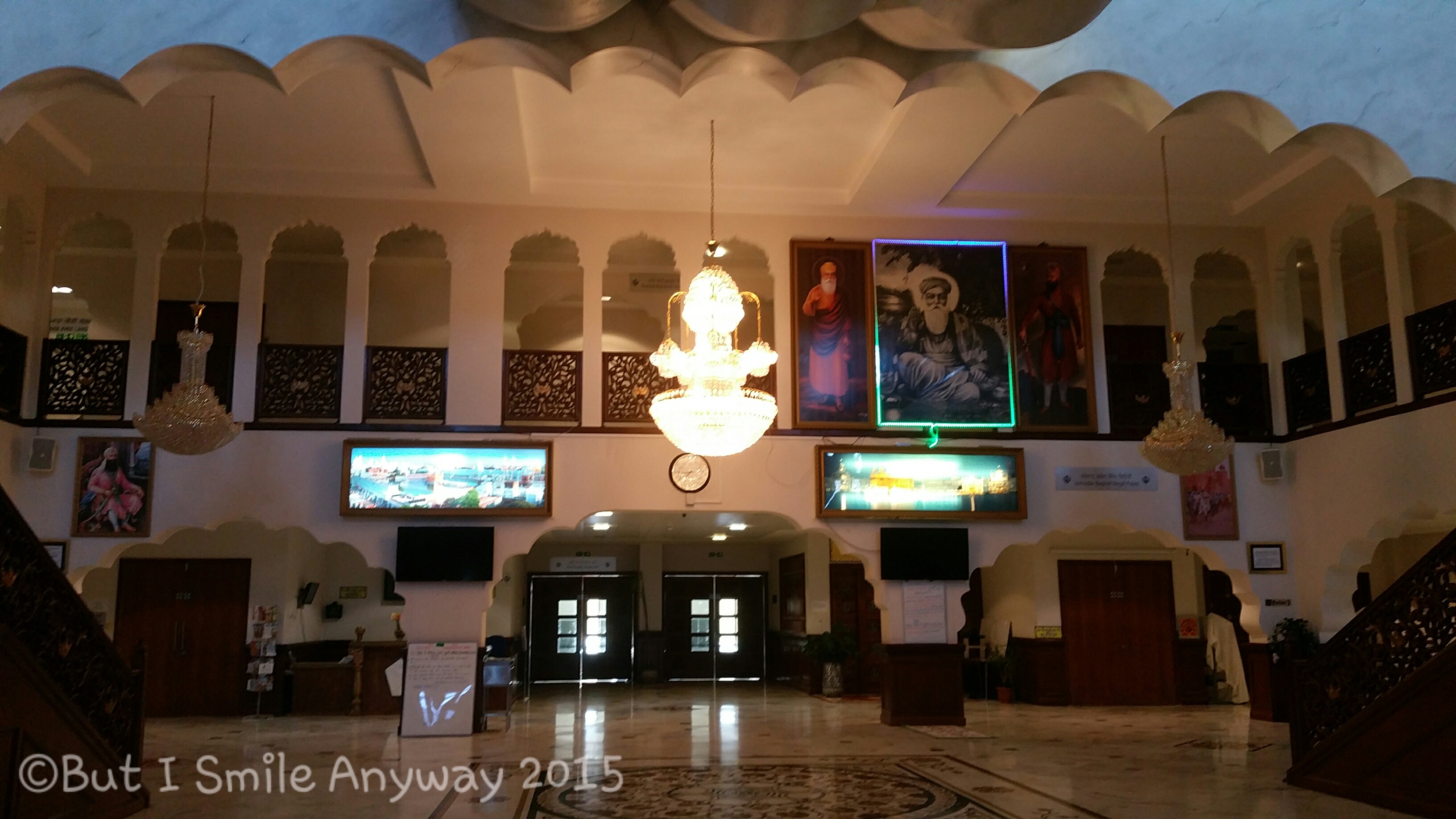
The Entrance hall

The Entrance hall

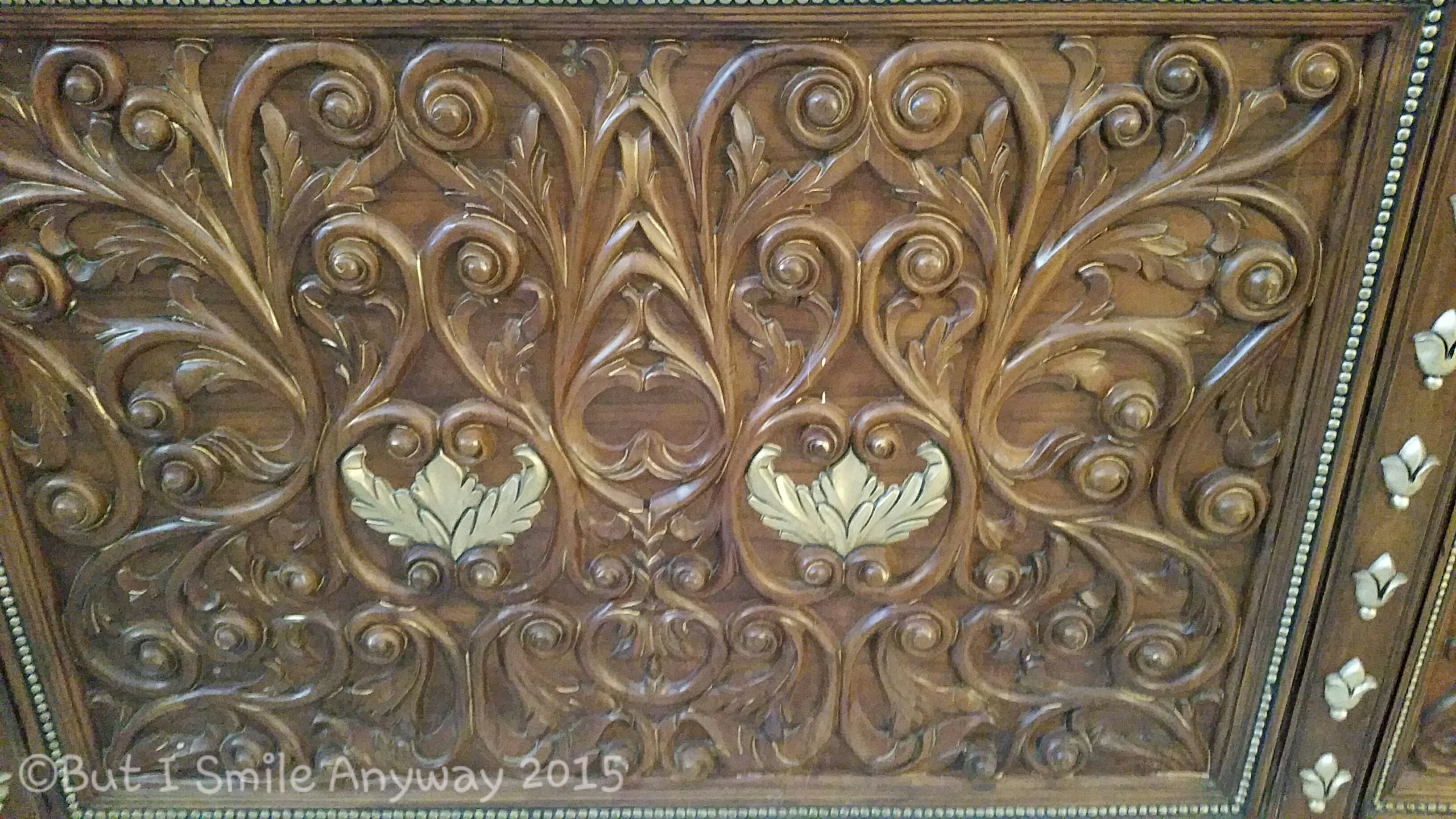
It’s a beautiful building, and there is amazing wooden carved panels, brought over from India, where expert carvers created the panels.

One of the panels

One of the panels

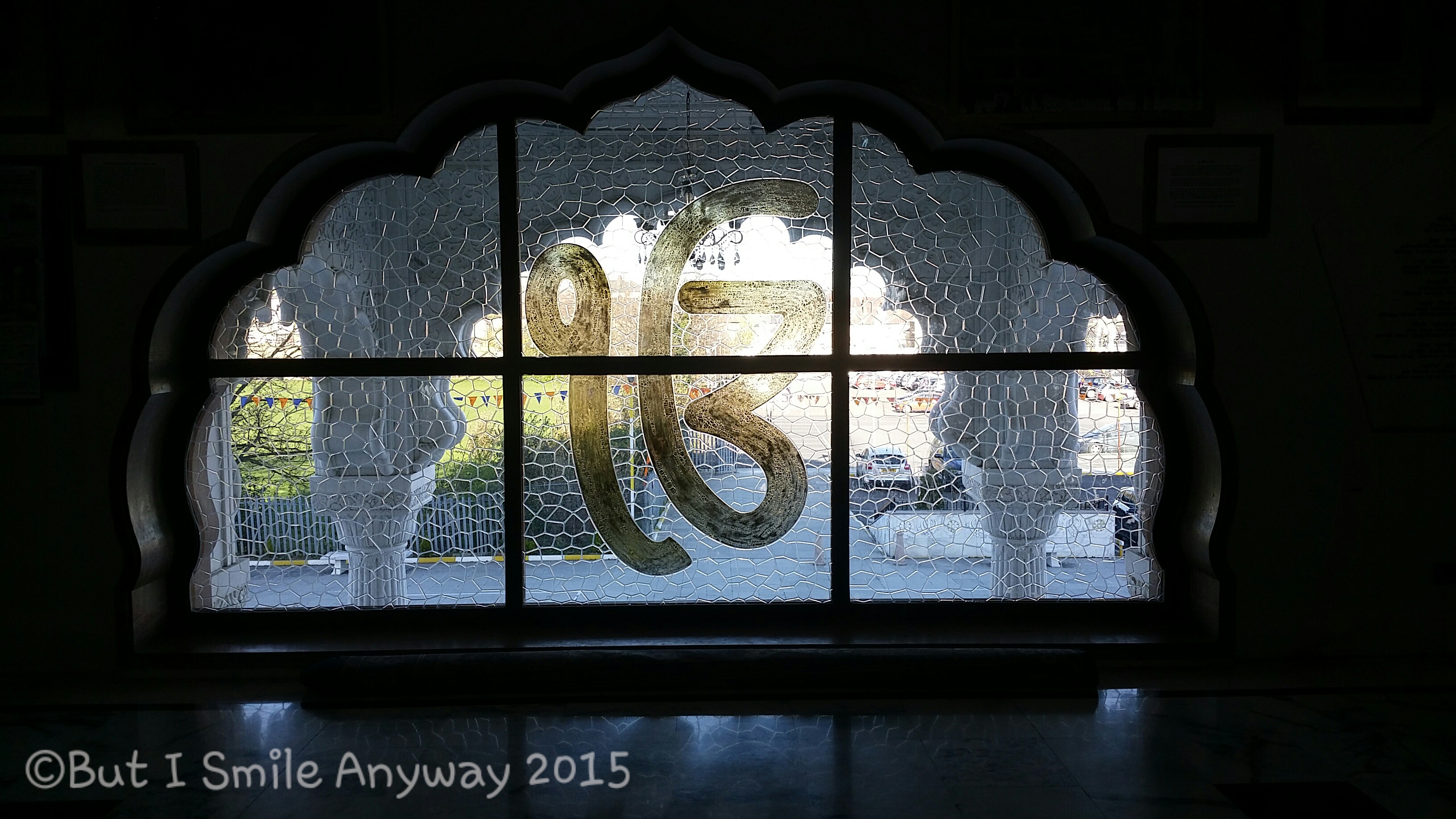
As you go up one level there is a stained glass window, depicting the symbol ੴ, Ek Onkar, meaning there is one God.

Ek Onkar

Ek Onkar

Then the domes that you can see for the outside are decorated on the inside with mosaic work.

The Outer Dome

The Outer Dome

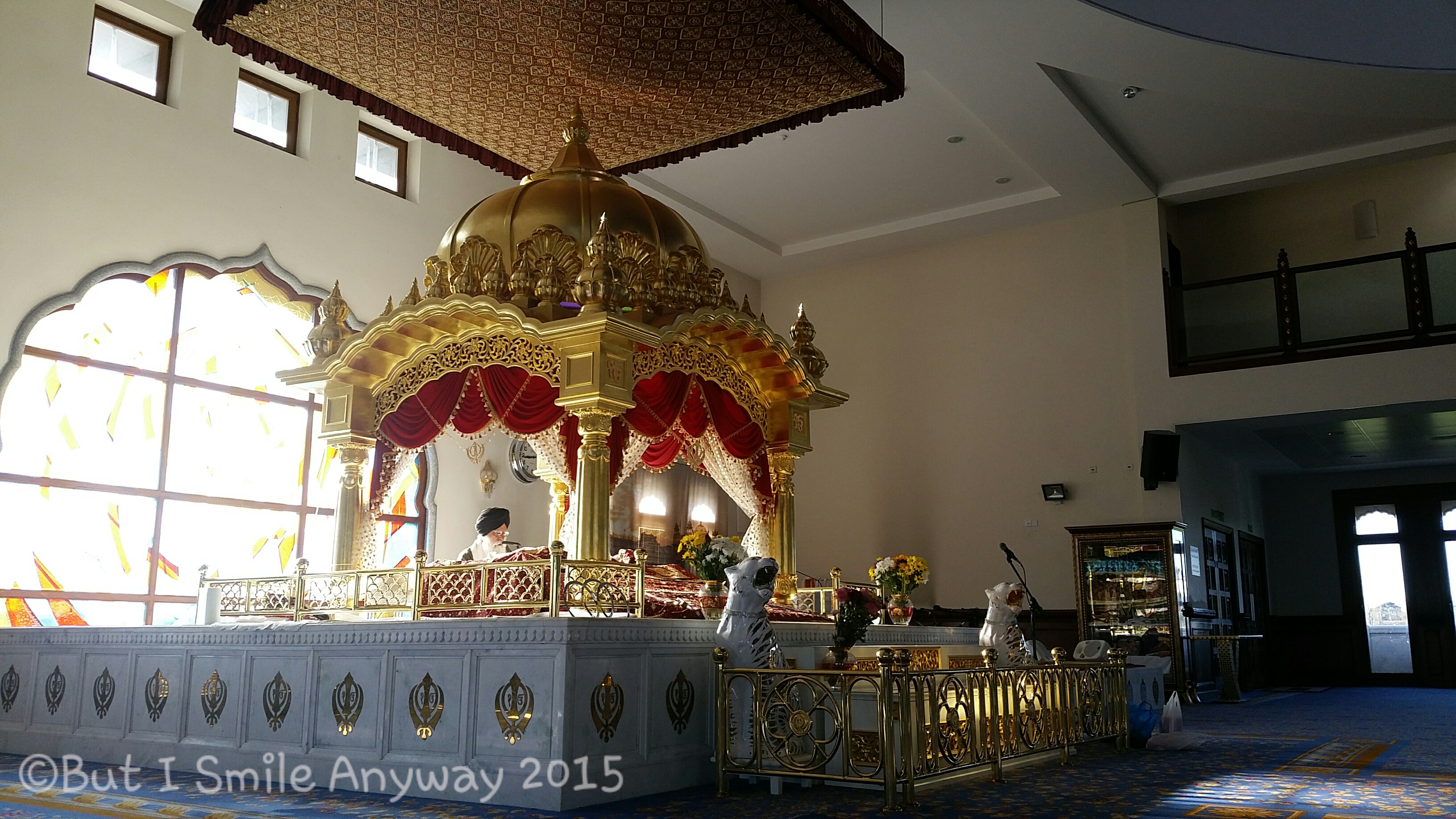
Then when you go inside the Darbar Sahib, to actually pay your respects, there is another stunning stained glass window, and the decorated area where the Guru Granth Sahib sits.

Prayers are happening

Prayers are happening

The stained glass window depicting the Khanda, our symbol of the Sikh faith

The stained glass window depicting the Khanda, our symbol of the Sikh faith

And again a beautiful dome with mosaic decoration.

The inner dome

The inner dome

We’re hoping to have a peaceful day now, at home, but there are still Karate lessons later!

Enjoy your day everyone!

But I Smile Anyway...

My interactive peeps!

  • Unknown's avatar
  • Unknown's avatar
  • Unknown's avatar
  • Unknown's avatar
  • Unknown's avatar
  • Unknown's avatar
  • Unknown's avatar
  • Unknown's avatar
  • Unknown's avatar
  • Unknown's avatar
  • Unknown's avatar
  • Unknown's avatar
  • Unknown's avatar
  • Unknown's avatar
  • Unknown's avatar
  • Unknown's avatar
  • Unknown's avatar
  • Unknown's avatar
  • Unknown's avatar
  • Unknown's avatar
  • Unknown's avatar
  • Unknown's avatar
  • Unknown's avatar
  • Unknown's avatar
  • Unknown's avatar
  • Unknown's avatar
  • Unknown's avatar
  • Unknown's avatar
  • Unknown's avatar
  • Unknown's avatar
  • Unknown's avatar
  • Unknown's avatar
  • Unknown's avatar
  • Unknown's avatar
  • Unknown's avatar
  • Unknown's avatar
  • Unknown's avatar
  • Unknown's avatar
  • Unknown's avatar
  • Unknown's avatar
  • Unknown's avatar
  • Unknown's avatar
  • Unknown's avatar
  • Unknown's avatar
  • Unknown's avatar
  • Unknown's avatar
  • Unknown's avatar
  • Unknown's avatar
  • Unknown's avatar
  • Unknown's avatar